
How to Avoid Talking about Gaza
The Impracticality of Practical Discourse

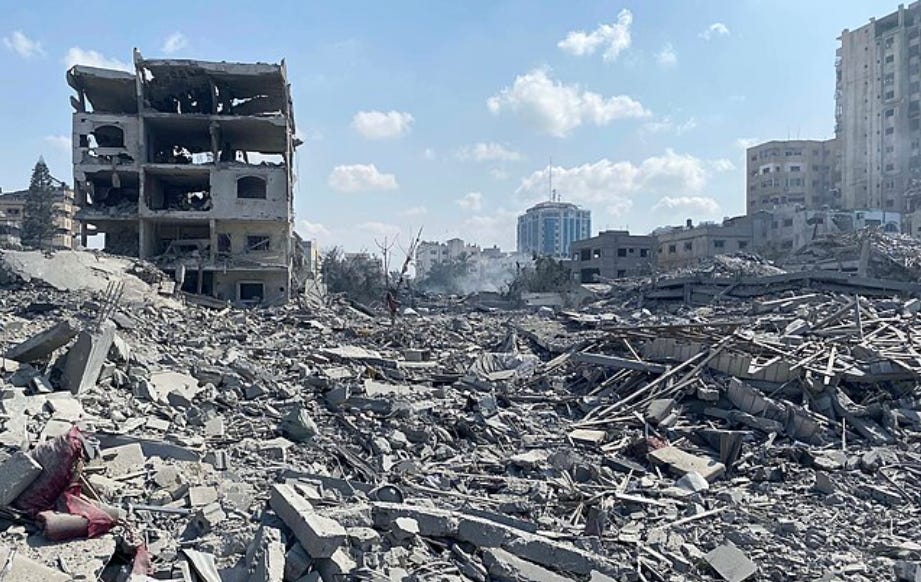
‘Act first, think later’ or ‘think first, in order to act’? Far from being a simple idiom and its gestural (and ironic) inversion, these appear to be today’s fashionable questions in navigating the 21st century’s own brand of political antagonisms. The latter alternative - that practical action presupposes our need to think about how to act, and what it theoretically means to act (in other words, that things are critical enough to necessitate the absence of action and a passive reflection) - is the leitmotif of figures such as Slavoj Žižek and Alain Badiou. The sobering failures of 20th century political projects, so they argue, require a period of theoretical speculation in order not only to retrospectively articulate what happened, but in order to constitute a substantial and effective political practice in the face of today’s social ruptures.
The prescription to stop acting, and to begin thinking, reproduces the familiar image of the Japanese WWII dive bomber (where pilots dove towards their targets and fired their bombs only seconds before they would have collided with them) or even the destruction of the Death Star in A New Hope (1977): a protracted, tense immobility, an abstention from reaction, which sets the foundation for an all the more effective practical outcome once action is deployed. In brief, practical discourse is an inevitable forerunner to effective practical action. Yet can the fetishised-heroic avatar of an X-wing fighter piloted by Luke Skywalker seriously be inscribed into our reactions to contemporary crises, or is there a dimension missing in the plea to ‘not act, just think’?
Žižek and Badiou’s reversal of the familiar phrase ‘don’t think, just act’ appears sensible: it would be reasonable to assume that practically focused discourse would result in practical and active implications. To insist that an idea is necessary, and to reflect upon a method by which it can be put into action, would presumably have direct material consequences. Unfortunately, a persistent paradox in recent political history reveals the opposite: by a strange inversion, practical-ethical discourse often sets the stage for an abstention from ethical action. The destructiveness of an act divorced from its theoretical ground is undoubtable, and yet a disappointing implication of political activism is the simultaneous impotence of the inverse alternative: practically oriented discourse - a ‘theoretical prelude’ to practice - justifies only itself, and precludes its own implied consequences.
This was one of the disheartening features experienced by many protesters against the Vietnam War. Early voices of dissent against US activity in South Vietnam - actively organising protests and making demands for scaling-back US involvement - produced anything but the desired results: the major escalation of conflict known as the Tet Offensive in 1969, and the ensuing destruction of civilian and agricultural production areas across Vietnam, Laos and Cambodia.
The inevitable question is therefore why practical discourse frequently produces an abstention of action rather than an ethical intervention. Why, in other words, practical discourse often is thoroughly impractical. The point of focus lies in the internally self-defeating kernel of discourse itself, its internal reproduction only of the conditions of its own possibility. In the second book of the History of Sexuality, Foucault recognises a similar anomaly. Sexuality for the Greeks was certainly not understood as a simple desire, as one drive amongst others that human beings must make do with. On the contrary, it had a more ‘universal’ function, colouring social and political questions. It was deployed as an ethical principle inseparable from the question of virtue and human flourishing.
Sexuality was regulated by practical guidelines outlining its role in various aspects of life: political office, marriage, honourable living, and the pursuit of truth. The accepted positions, frequency, and emotional significance of sexual activity were adjusted according to social status, time, season, and individual traits. Even Greek pederasty was subject to detailed rules and customs, aimed at promoting a practical and ethical approach rather than frivolity. The practical discourse on the politics of sexuality had a clear, albeit unusual, consequence: sexuality became something that was frequently abstained from, with sexual interactions being so much subject to practical presuppositions that it rarely became an actualised behaviour. In other words, opening up a topic to practical consideration often meant never in fact directly actualising those considerations.
In this sense, the difficulty faced by political activism is that practical discourse has impractical consequences. This practical approach is made up of a theoretical, speculative centre; an empty core ‘filled in’ by an immobile reflection upon its ethical intention. When practical solutions are most needed, they seem all the more ineffective. This is unfortunately the present case with Gaza. The question we should therefore be asking is not ‘what should we do about Gaza?’, but ‘how do we not talk about Gaza?’ What type of discourse about this humanitarian atrocity is required so as not to suffocate its effects in their very conception?
The body politic seems to side with Palestinian freedom to a greater and greater extent. In only four months since October 7th, British popular opinion showed increased sympathies with Palestinians, a greater percentage of people believing that Israel’s attack is unjustified and that peace talks with Hamas are becoming a growing necessity. Whilst a majority of Americans believe that Israel has valid reasons for fighting Hamas, public opinion across the West is showing a greater sympathy for the devastation in Gaza and support for Palestinian freedom. Protests and occupations calling for a ceasefire, as well as policy suggestions on how a ceasefire can be achieved with a practical vision of a resolution in the aftermath, have acted as a backdrop to Netanyahu’s rejection of a ceasefire and an escalation of military violence across Gaza.
Even with what can already be called the war between Hezbollah and Israel, and the potential for greater Iranian involvement, condemnations by Western governments of Israel are revealing themselves to be purely gestural. It is the impersonal indifference of the ‘big Other’ in which demands are registered, each demand neutralising itself is if it carried in itself its own negative correlate. The Westernised big Other of Gaza is the symbolic helplessness of a purely virtual recognition of popular opinion, which by its transient sympathy lays a far more real foundation for continued violence in the Middle East. For political activism, discourse on ‘how to do it’ appears far too often to lay the ground for not doing it, or to be received by an absence of practical outcomes. The necessity of recognising the impractical kernel of practical discourse is being thrust upon us, with the question of ‘how to talk about Gaza’ falling into the more perplexing question of ‘how to not talk about Gaza by talking about it practically’. When discussing Gaza, the distinction between 'theoretical' and 'practical' is becoming inadequate. Any popular ‘mobilisation’ must instead recognise the speculative component to its own plans for practical activity.
That the Gaza conflict is difficult to solve is merely a truism. Yet the secondary difficulty that is constantly being ignored is of finding the simple coordinates to talk about Gaza. This difficulty to speak is represented by the repeated failures of practically oriented discourse, which constitutively counteracts its own premises. The internal remainder of practice is its theoretical discrepancy. Any practical discourse, if this term can still be considered useful, must therefore embody its own self-contradictory remainder, the speculative interruption lodged in the ‘how to…’ cannot be persistently be reduced to the isolated, theoretical obverse of practice. It is clear that we all too often talk about Gaza as a disguise for not in fact talking about Gaza. The intention of this article is not to provide a manual for discourse, but rather to recognise an enigmatic limitation, to recognise that when we talk about Gaza, it is often Gaza itself1 that is left out of the conversation and substituted with a displacement of agency into a virtual, indifferent register. We could argue that where contemporary discourse is concerned, there are two versions of Gaza: the virtual-Ptolemaic Gaza which we solipsistically resign to the responsibility of the big Other, and the real Gaza, a disruptive and self-obfuscating point, a critical symptom of (or contraction in) the false universalism of global capitalism.
Practical discourse should extend beyond its usual boundaries to address the tensions and standard arguments used by Israel supporters, which they use to reject the very idea of practice itself. The destruction of the Oslo Accords by Hamas; starting the timeline on October 7th without acknowledging Israel's prior violence; the seemingly antisemitic stance of the Arab alliance during the early Arab-Israeli wars, lasting until the Yom Kippur War of 1973; and the failure to compare the atrocity of October 7th to the brutal excesses of Israel’s response - these are only some of the commonplace reactions to any practical activity, which are relegated to the retrospection intellectual debate. Any discourse which therefore takes its task seriously should be a discourse in which its own negations are embodied, in which theoretical reflection takes on a practical value. We cannot formally insist on an ‘act’ without framing the tendency of this act to efface itself. Practical discourse must in this sense be reconsidered for its theoretically active tendency, in order to not continually fall back upon its paradoxical impotence, and in order for us to truly talk about Gaza when Gaza is being discussed.
As with any symptomatic point in an economic-humanitarian crisis, Gaza is traumatic enough to avoid a stable narrative legacy, to act as both thesis and antithesis, or even to obscure its own meaning in the act of being mentioned.