
The Freud Variations
Titanic (1997), 'Neuropsychoanalysis', and the Maltreatment of Freud

For the theorist or philosopher, biography can be parasitic - that is, the biography of a philosopher can act as a parasite for this same philosopher’s body of work. Not simply in the sense that it becomes a preoccupation, a deviation from our sterile view of them as theorists, but in a more radical sense: biography steps out of its humble position, and casts a shadow on theory as a whole - it reworks theory, treating it as its zombified host. At a certain point, we seem to become more interested in Nietzsche’s supposed personal eccentricity than with the eternal return, more lamenting of Sartre’s unrequited love for Simone de Beauvoir than with his phenomenological ontology, or more drawn by the sex lives of the German Idealists than by their systems - resulting in the inevitable decomposition of the eternal return, phenomenological ontology, and German Idealism.
More than any other thinker, Freud has suffered this biographical infection, his theory being reduced more and more to a product of his personal life. Still today, an unwavering tendency persists in treating some of Freud’s most innovative breakthroughs as byproducts of his own emotional life. The ‘death drive’ is a perfect example here. In 1920, the death drive was the eventual outcome of a theoretical impasse: the paradox of a form of repetition which persists despite not yielding any form of pleasure - an enjoyment in other words, which is irreducible to pleasure. This enjoyment that seemingly negates itself is what Freud called the death drive - a stylised and impersonal tendency towards auto-destruction. Yet soon after this conceptual drive was hypothesised, (mostly British) psychoanalysts - unable to grasp the paradoxical meaning of such an enjoyment that act against itself - insisted on reducing this discovery to Freud’s personal turbulence. The argument is almost a straw man of itself: ‘Freud invented the idea of the death drive to cope with the destruction he witnessed with WWI.’
As Laplanche would decry in his seminar on the unconscious and the id: is there a greater insult to a theorist than this injustice done to the Freudian death drive? The latent implication in this reduction of a theoretical principle to biographical events is a sincere denigration of Freud’s capacity as a reasonable theorist. Where theory is concerned, creator should never be present in creation. Where biography is introduced to theory, it becomes clear (such as for sections of British psychoanalysis) that the capacity for theorising is stopped in its tracks.
Yet the reverse of this formula is equally as possible: not only does the creator’s existence sometimes unjustly bleed into their creation, at other times the creation deploys a retrogressive effect on the creator. There is an unconscious to Freud’s theory - this was one of Laplanche’s presuppositions in the New Foundations for Psychoanalysis (in which the enigmatic signifier, the general theory of seduction, and the Copernican revolution of the unconscious were fully formalised). Freudian theory is imperfectly recollected even when Freud himself was made to recollect his theory.
The Introductory Lectures, for example, reduce many of Freud’s discoveries to the simplified drive model that would be adopted by a host of vulgar interpreters of psychoanalysis, or to the censorship mechanism so ruthlessly criticised as a ‘magical entity’ by Sartre. The vicissitudes of psychoanalytic ontology, of subjective self-alienation, and of phenomenologically commensurable unconscious formations - so present in Freud’s early writings as well as his later speculations on enjoyment and fetishism - are nowhere to be found when Freud recollects his own discovery. By an inversion of creation upon creator, Freudian theory is subjected to its own auto-repression.
In other words, psychoanalysis must contend with the fact that Freud’s legacy reproduces the same distortions, displacements, repressions, inversions, condensations that he had himself located as the structures of expression of unconscious formations - that the ‘impossible knowledge’ of the unconscious (as an academic doctrine and as a subjective entity) is expressed only insofar as it is distorted.
In an identical way, Freud is recalled predominantly as some abstracted caricature, as a gestural cultural icon whose trace is as purely aesthetic as it is irregular (this stylised formality of Freud as an uncomfortable shadow over Western decadence is perfectly recreated in Ballard’s Atrocity Exhibition). To refresh Freud - or even to ‘Freudianise Freud’ - entails recognising that as a cultural figure (and Freud’s intervention was undoubtedly on the level of ‘culture’ as a whole) he has been reduced either to cinematic or literary ‘equipment’. ‘Equipment’ precisely in the Heideggerian sense: used insofar as it is simultaneously repressed, or insofar as any equipment-use is a latent obfuscation of the discarded reality of the thing used.
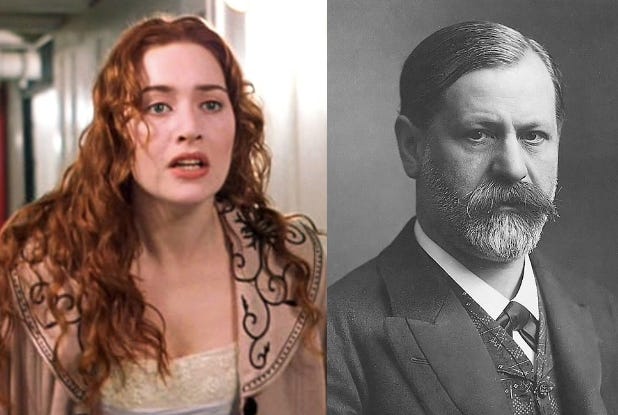
Freud is equipped as a source of supposedly high-brow quips, of ‘learned insults’ such as the ones recycled by Sheldon in Big Bang Theory (Leonard’s hopeless romantic pursuits are summarised as a ‘classic Freudian crisis’). Freud is the source of supposedly ‘intelligent jokes for intelligent people’, received only by the disinterested viewer unperceived behind a persistently dissociative canned laughter. In James Cameron’s Titanic (1997), Freud is used by Rose as a great pillar of dissent against the obverse great pillar of 20th century technological progress. Dissatisfied with a decorated dinner during which the Titanic’s ‘idea man’, Bruce Ismay, boasts of his desire for grandiosity and unparalleled size, Rose snaps back at Ismay, suggesting that Freud’s theory of the masculine obsession with size (revealing an underlying impotence) may be of interest to him, before briskly leaving the table.
Yet this uncomfortable popularisation of Freud is the inverse consequence of his simultaneous vulgar appropriation by more ‘serious’ academic pursuits. Outside of popular culture, Freud is subject to the same ‘equipment’, a similar functional obfuscation and denigration. He is used, for example, as a weak reference point for contemporary sciences. With various attempts to integrate Freud in contemporary clinical psychology - or even more prominently in the emerging field of neuropsychoanalysis - Freud is framed according to a simplistic drive theory. The basic coordinates of this argument is that pleasure is externally limited - or repressed - and that neuroanatomical correlates to this process can furnish a neurological explanation for psychoanalysis.
Such a use of Freud borders on the nonsensical, and rejects the inherent contradictions and auto-negation (the masochistic tendency of pleasure to deny itself) that Freud locates as central to subjecthood. I have argued elsewhere (ironically, for a journal managed by the American Psychological Association) for the need to rethink the neuroscience-psychoanalysis relation, in order to embody the reciprocal paradoxes presented by both, yet neuropsychoanalysis appears to persist unscathed. In this sense, both in popular culture and in academia, Freud is used only insofar as he is misused.
Recognising this two-way obfuscation (a functional misuse) is the first step towards vindicating Freud as a theoretically rigorous figure. The second step is to continue to explore and defend the sophistication of various, independent Freudian categories. To adapt Deleuze’s formula: to experiment with, and in so doing recreating, concepts - to determine concepts from the perspective of their unexhausted interiority. In other words, to see in each of the categories of fetish, enjoyment, censor, latent vs manifest content, death drive etc. a disparity in relation to itself - a for-otherness with which we complete these these categories in their meaning not simply for ourselves but for Freud himself.
The warning of Susan Sontag and the anti-interpretationist ripple originating in the 60s is still felt today, and yet is often treated as if it never occurred. The crucial message of Sontag’s anti-interpretation was not that we must merely end any form of interpretation - after all, even the strategic aesthetic formalism which she exposes is a formality determined by the observer, completed in a sense by an always-active interpretational energy. On the contrary, Sontag’s message was that interpretation should not treat either of the two agents of the interpretational relationship as internally complete.
Psychoanalysis is not a fully formed doctrine which, like a dying star expanding into a red giant, spreads outwards and consumes/appropriates its surroundings (whether these surroundings be a piece of literature, a film, a cultural phenomenon, or a work of philosophy). Instead, psychoanalysis is internally irregular, it is an intervention in the history of ideas which seems to immediately begin working against itself - and for this reason is determined in turn by that against which it is interpreted.
‘Bad’ interpretation, the one targeted by Sontag, still presupposes a certain superiority, or greater completeness, in the doctrine interpreted with over the interpreted thing. For Freud, this is flatly untrue - interpretation is a two-way movement, in which Freud becomes himself, by his ex-centric situation in that which is not psychoanalysis. Modernity (if this word does not today immediately contradict itself) offers an endless series of political paradoxes in which Freud can be rescued from his lifeless dissemination into the 21st century. For now, I hope that it suffices to point out just a few modes in which Freud can be re-articulated:
Firstly, the incommensurable rupture between pleasure and enjoyment introduced by Freud most notably in two successive stages. In the Three Essays on the Theory of Sexuality, Freud shows that sexuality - the ’social’ coordinates of sexual enjoyment, are furnished first and foremost by a loss, by a failure of any form of immediate pleasure: the impossible pleasure of the maternal object, from which the non-existence leads to an eternal search (Wiederfindung) for a virtual spectre, a pure negativity which itself becomes the source of a mediated enjoyment of the lack of direct pleasure.
Fifteen years layer, and under the guise of a speculative enquiry into the origins of repetition compulsions, pleasure is opposed to enjoyment in the form of the death drive, in which a perverse and auto-destructive enjoyment is the only way out of a permanent tension which leaves pleasure unattainable. This opposition of enjoyment to pleasure serves as a crucial alternative to the homeostatic pleasure-pain model (the simple biological view of a ‘tendency’ towards pleasure and away from pain) which plagues the appropriation of Freud into neurobiology. The structural self-contradiction of enjoyment is fundamentally a social function, one which provides a method for understanding the ideological mechanisms of a political enjoyment that seems to only serve a destructive purpose. As Reich put it, one of the paradoxical realities of social groups is a certain ‘enjoyment of oppression’, an enjoyment which must be approached psychoanalytically, and which in turn illuminates Freudian theory.
A second point of experimentation is the psychoanalytic insight of the internal counter-productivity of knowledge. Knowledge seems, both on the personal and on the ideological level, to function insofar as it simultaneously rejects itself: by admitting something, we latently reject it. The most quick-to-the-point example used by Freud is a conversation about death between a man and his wife, in which the former says: If one of us dies, I’ll move to Paris. ‘Death’ (the possibility of death) is in one sense fully admitted (‘one of us will die’), yet this very admission makes possible a more determinate rejection of this knowledge (‘it will after all be my wife, not me, who dies’). This phenomenon was termed Verleugnung by Freud, and has with the help of Octave Mannoni and very recently Alenka Zupančič (in her book Disavowal) been expanded as a fundamentally ontological category, which by strategic exploration can help account for the malleability and apparent robustness of ideology in the face of counterfactual information.
The next focus should be on Freud’s description of the retroaction of traces upon scenes, the effect of recollection, in other words, upon that which is recollected. Between 1895 and 1914 (from the Project for a Scientific Psychology to the Wolfman case), Freud notably stumbles across a certain inversion of common sense notions of temporality, by suggesting that re-presentation furnishes the coordinates of the original presentation. Traces are for Freud simulacra, reproductions of incomplete, or retroactively attributed causes. Is this retroactive (Nachträgliche) attribution of origin not a commonplace factor of political formations, which form central-less multiplicities of ‘performative effects’ (to borrow a term from Graham Harman)? The rise in right wing populism is precisely such a formation, radically adaptable only because it furnished the demand to which it supposedly answered only after it has provided an answer.
There are, of course, a near-infinite number of ways in which Freudian discoveries can be experimented with and vindicated by their conceptual modernisation - this is in part due to the inevitable unawareness which Freud had of the weight of his own breakthroughs (signalled in part by his incorrect attribution of the unconscious as something already discovered - the unconscious was of course a category for philosophers such as Schelling and Schopenhauer, but none of these are directly reconcilable with the linguistic-metapsychological unconscious of Freud). I intended only to point to a few of these here, and more generally to make a case for possible ways out of an ever-growing appropriation of Freud (whether aesthetically or scientifically) which renders Freud himself an unrecognisable distortion of his own radical potential.