
Manosphere Marxism
The Political Economy of Impotent Misogyny

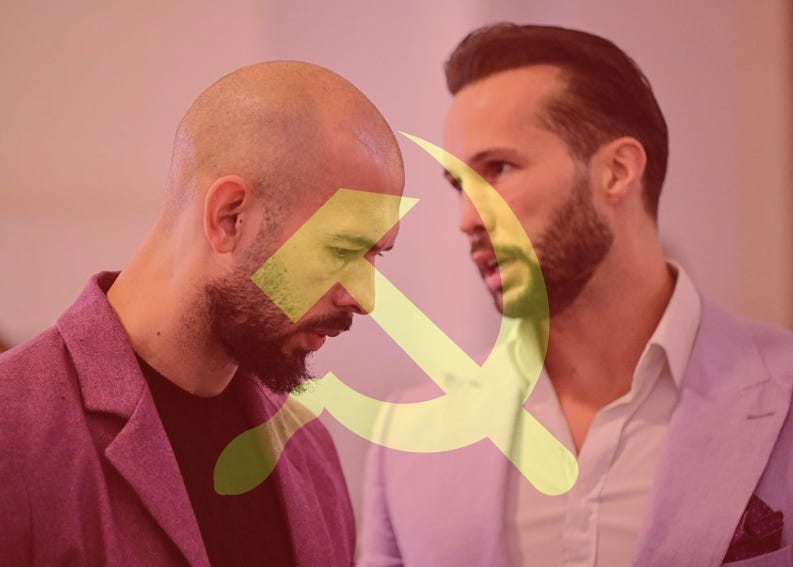
Andrew and Tristan Tate have once again been arrested on additional counts of trafficking, rape, and even child pornography. Any disinterested observer could guess that this would quickly be met with the usual rhetoric that the charges are fake, that the Tate brothers are political prisoners who are being targeted because they “speak the truth.” I have no intention of debating the validity of charges brought against the Tates. If the manosphere representatives do speak some form of truth, it is a very accidental and contradictory truth, and a truth that they are likely unaware of.
There is a strange tension at the core of the manosphere ideology: it forcefully opposes the destruction of masculinity in a feminised Western modernity, and yet at the same time the manosphere avatars seem to ridicule their own opposition. The return to traditional masculinity is on closer inspection not a ‘return’, but rather an accelerated and farcical abstraction of the spectre of manliness. Rather than orchestrating some form of global anti-feminine camaraderie - a unification of men for men - the manosphere’s special brand of misogyny comes with a simultaneous denigration of men themselves. Masculinity is not framed as inherently respectable, but rather as the unrealised idea glimpsed through a spectacle of hystericised and provocative jabs at irrelevant topics, a denigration of free creative pursuits, a fetishisation of status through buying expensive cars and encouraging 14-year-olds to alienate themselves from classmates, and an evident terror at the idea of love and devotion.
The ‘man’ of the manosphere is, in this sense, the noema of Husserl’s noesis: it is the essence which is implicated, but endlessly subtracted and unachieved, by an indefinite number of perspectives and frameworks on this very essence. In other words, it is the kernel that is erased alongside our attempt to grasp it, the absent referent to a system of imperfect descriptives. The manosphere may provide a plurality of attacks on feminist progressivism, but it doubles these attacks by erasing the very idea of a ‘man’ that it defends. Instead, we get a type of simulated, hyperreal internet-masculinity composed of senseless neologisms, post-playboy ethics, and performative declarations of a superior ‘status’.
The manosphere certainly does contain some form of political or cultural power. At the same time, however, this power is little more than its own jester: it is not a serious reaction to an unserious postmodern era, but rather a self-reflexive implosion of gender into its own perpetual trivialising. If we live in an unserious age of feminisation, then the manosphere is little more than the unserious construction of a caricatured masculinity. But it is here that we can begin to recognise a fundamentally Marxist relevance to the rise of the manosphere, particularly if we look back to The 18th Brumaire of Louis Bonaparte, Marx’s incredibly detailed account of Louis Bonaparte’s (Napoleon’s nephew) erratic coup d’état in 1851.
The destabilisation of established political classes and economic alliances in 1840s France - especially following the bourgeois, anti-monarchist revolutions across Europe in 1848 - provoked neither a ‘serious’, sustained reactionary monarchist movement nor a continued revolutionary intensity. Instead, France’s disorder at the beginning of the 1850s folded into a ridiculous counter-tendency in the form of Louis Bonaparte’s opportunistic and pandering unpredictability. By manipulating the pluralised tensions between the old royalists, the peasants, petty-bourgeois, social democrats, poorly defined nationalist parties, or the new revolutionaries, Louis Bonaparte created several precarious alliances that allowed him to assume control of France in December 1851. Any yet he did so with such an absence of any real political agenda that his new government failed to represent even a single French political group. As Marx famously insists, Louis’ power was an impotent and farcical power which hopelessly imitated the true tragedy of his uncle’s rule.
The manosphere is in many ways the perfect embodiment of this gestural Louis-Bonapartist power: a self-denigrating power that acts as a farce of itself. One of Althusser’s great formulations is that ideology conceals what it lacks - not by suppressing it, but more paradoxically by continually reproducing and referring to this very lack. There is no ‘depth’ to ideology, there is nothing behind its distortions. Instead, ideology is a type of functional, necessary distortion - it does not need to conceal its failures, since it functions because of these failures. As Chesterton puts it in his defence of Orthodoxy: Christianity functions because it seems to be contradictory, because it can account for opposed and mutually exclusive propositions and criticisms.
In the Althusserian sense, the centrally reproduced message of an ideology points to a hole or disturbance in this ideology: capitalism will speak of ethical and social duty because exactly this ethical duty is what is missing in the most effective, profit-driven capitalists. We see a similar argument in the early works of Freud: when early cultures created multiple phallic effigies, it was a sign not of this culture’s symbolic potency, but of the fact that they are already castrated, that they are already submitted to a de-centred paternal law. More generally, where dreams or ideological productions endlessly refer to one idea or one thing, it is because this very thing has already been lost. Similarly, the manosphere’s aggressively reproduced image of masculinity centres around a failed articulation of the fundamental notion of ‘the masculine’.
For anyone who had the patience to watch the whole of Louis Theroux’s recent documentary, Inside the Manosphere, a very precise example of this presented itself. The influencers followed in the documentary all had one specific point in common: they claimed to have decoded the essence of the male-female relation, to have successfully navigated the dating-game and the easiest way to become desirable to women. The paradox, however, is that the position of ‘the woman’ is absolutely excluded from their speculations on female decadence or the power of money. The average manosphere doctrine is that women need to be controlled by powerful men, that they desire superficial forms of domination, and that the ‘provider status’ of men grants them the authority to be unfaithful whilst women have a duty to be faithful.
But the moment of brilliance of the documentary was to contrast this ‘knowledge’ of women with the “alpha male’s” unexpectedly censored behaviour in the actual presence of a woman. Both Myron Gaines and Justin Waller boasted of their sexual exploits and infidelity, and of the more brutal fact that their partners have no say or right to an opinion on the matter. And yet when these ‘partners’ are in fact interviewed, any initial confidence is reversed into a timid indecisiveness: suddenly, a type of understated diplomacy is employed. In the absence of any female presence, manosphere acolytes carelessly boast of their sexual decadence and the subservience of their partners - but when these women are there, much of their confidence is quickly lost. Waller of Gaines are reduced to edgy but insecure teenagers, unwilling to repeat what they’ve been saying about their women in front of said women.
The manosphere’s claim to “understand” women is, in a Marxist or Althusserian sense, an ideological veil to their radical fear of something approaching femininity. Rather than embracing a certain contingent openness or irreducible enigma to the romantic encounter, they employ the reactionary position that there is no enigma to consider - that women are “easy”. They reject love because they refuse the radical romantic abyss of a confrontation with the other that love inherently demands. The manosphere epistemology is in this way close to the logical positivists: in their inability to negotiate any metaphysical or ethical alterity, they deny the very existence of this alterity.
Two crucial (Marxist) questions emerge at this junction: (1) what do we make of Marx in the era of the manosphere? and (2) what Marxist elements can be discerned in the erroneous logic of manosphere discourse itself? The answer to 1 seems clear enough. Contrary to the dismissal of moderate or progressive socialists as well as reactionary liberals, Marx’s Capital is increasingly relevant in the AI-fuelled, populist capitalism of the 21st century. Marx predicted the violent reactions of capital to its own inevitable contradictions - with Volume III being directly focused on the social implications of this entropic, self-correcting logic of capital.
If capital is internally unstable and often counterproductive - if, as Marx argues, an ‘anti-capitalist tendency’ always grows at the core of capitalism - it nonetheless has many experimental countermeasures to the threat of diminishing rates of profit: interludes into violent foreign war as an economic principle, creating new forms of technological exploitation and reductions in necessary labour time, or even the infringement of capital into private spheres of communication of existence. The ideological distortions of neoliberal globalisation, including the manosphere paranoia, is no exception to this ‘reaction of capitalism to capitalism’.
The answer to question 2, however, is more precarious: this is not simply about the various Marxist critiques which can be applied to the manosphere, but rather the subtle and unintentional Marxist ‘ring’ of what is otherwise manosphere nonsense. The real critique of political economy is achieved not just by dismissing or ignoring dominant cultural or political discourse, but by a critical engagement with this discourse - as Derrida would put it: to see within this discourse its own counteractive, and deconstructive potential. Much like Oscar Wilde was able to twist and rearrange English bourgeois ethics into a more radical and paradoxical truth (with his famous slogans like “Life is far too important a thing ever to talk seriously about it” or “Being natural is simply a pose, and the most irritating pose I know”) the critique of political economy doubles this political economy into a critique of its own presuppositions.
And in this context, the manosphere is certainly a product of a more generalised entropy in our current political economy. Manosphere Marxism therefore implies discerning a critique of capitalism within the confines of Andrew Tate’s or Justin Waller’s hyper-capitalist ramblings. In one of his typically boring ramblings, Andrew Tate makes the observation that most business teachers/lecturers drive worse cars than Tate himself. Why, then, go study business when you should just go do business and get rich. The message is clear: ‘university is a scam - you study for a four-year business degree when you could be out making real money.’
Something about this chauvinistic and desperate performance nonetheless rings true even for the critical leftist. Specifically, that the modern university has failed to live up to the duty of a university. Today’s superfluous educational institutions are largely reduced to offshoots of the business industrial complex - they are little more than mediators between youth and corporate capital enterprises, a place to pick up degrees in business, finance, security, or strictly economically beneficial STEM fields. With right-wing censorship of the humanities, it is true that universities are becoming a waste of time. The answer, of course, is not to dismiss education as whole, but to stress the immanent necessity of philosophy, literature, sociology, political theory, theology, cultural studies etc. in decoding and offering alternatives to our current social deadlocks.
If the manosphere stresses the value of luxury and a perverted revival of high-life aesthetics, it is worth recollecting one of Terry Eagleton’s conclusions from Why Marx was Right: ‘luxury’ and ‘socialising the means of production’ are not mutually exclusive. It is in fact the private ownership of most global capital that insures the oppressive commercial servitude of the majority of the population. That capitalism is not only not oriented towards generalised luxury, but inherently opposed to luxury is latent across Marx’s Capital and directly (although maybe imperfectly) theorised by Aaron Bastani in Fully Automated Luxury Communism.
The manosphere can easily be read as the latest, most extreme iteration of an individualist ideology which relies on capitalism as its apparent condition. Individualism is indeed deeply fettered to the dawn of European capitalism, through the specific blend of classical liberalism and industrialisation that followed the Enlightenment. And yet any honest reflection quickly shows that true individualism and capitalism are ultimately enemies rather than accomplices. One of the central contributions of the Frankfurt School was showing precisely this - the forms of ‘individual expression’ promoted by secular capitalist society rest on a myth of individuality which conceals a more radical collectivism. Consumerism allows us to choose anything we want in our fashion-style, our newspaper subscriptions, or our choice of fast food - and yet all the options are identically subsumed under the unquestionable logic of capitalist reproduction. The pluralities of consumerism all point back to the same restrictive economic ground: capitalist consumerism never offers the alternative of the non-capitalist commodity. You must choose capital - consume however you want but you must consume at the cost of the environment and global economic destruction - and the resultant individualism is nothing more than a paradoxical expression of the deeply collectivising function of modern capitalism.
In a broader sense, the great stylistic method of The Communist Manifesto is its simple yet effective inversion of the very clichés directed against communism. “Communism wants to destroy the family unit!” No, Marx and Engels reply, it is capitalism itself which insists on submitting every aspect of private life to political economy even at the cost of the family. “Communism wants to demystify the world!” Once again, it is capitalism which reduces the social sphere to the principles of exchange value and capital circulation. “Communism rejects the idea of the individual!” But it is capitalism that relegates the majority of the global population to undifferentiated workers who are unable to pursue any meaningful individual projects.
The manosphere ideology is of course substance-less nonsense. And yet it permits itself to be read like any other ideology: as comprising a critique not only of what this very ideology proposes, but of the political situation in which this ideology arises. Established political discourse is quickly collapsing - we are negotiating existential impasses (climate change, volatile geopolitical alliances, economic collapse, nuclear war) that the old liberal democratic framework cannot resolve. The manosphere is one of many possible symptoms of this disorientation. Whilst we will never all become infantile billionaire misogynists, as a symptom the manosphere easily acts as an indictment of its own position - much like the comedian whose main ‘bit’ is placing his own position as a comedian into question: where the comedian simply ‘says things as they are’ and the audience inevitably laughs. The Marxist position towards the manosphere remains two-fold and open: to understand how the manosphere arises as a reaction to our current political economy, and to frame the manosphere as immanently critical of capitalism itself.
This is great.
you missed the bit about the Tate's subscription-based scheming scam-lifestyle, no doubt for space, but that's pure capitalism without the capital, it's all about the list of patrons, not the production, or the means thereof, totalisation no-choice capitalism has no capital, but still manages to capitalise. And then the poor schmucks are fed to the monster. Trump did all of this with real estate... other people's money too.