
Is Violence Possible Today?
Justifying Violence via Klein, Benjamin, Movie Villains, and Schelling

Long before the 20th century period of structuralist critiques of ideology and even before Kafka, Tolstoy pointed out a strange discrepancy at the heart of effective bureaucracies: bureaucratic organisations, with their dense division of duties and opaque systematic methods, do not function because every one of its members is ‘in on it’, because of the fidelity or belief of its employees regarding the goal of the organisation. In fact, a powerful bureaucratic system functions paradoxically by relying on the passivity and ineffectiveness of its members. Stephen Oblonsky, of Anna Karenina, is just such an example of the logic of ‘effective inefficiency’. He is described as somewhat lazy, an unreliable socialite, and a disinterested middle management officer of Russian “Society” life. But it is this very infidelity, his lack of any serious dedication, which makes him such a great bureaucrat. Imagine, for example, a modern investment firm, social media company, or major insurance provider, all of which claim to have found ethical alternatives, to put the consumer or client first: a new recruit who told his bosses that they were truly excited to prioritise customers and make an ethical difference would surely be fired very quickly. His enthusiasm would quickly transform into disappointment once he realised that the ‘ethical’ business is merely a front for more advanced forms of economic appropriation and manipulation. In order to truly fit in, a new employee would need to already have tacitly acknowledged that this claim to being ethical is a complete farce.
If ethical alternatives to exploitation furnish their own form of exploitation, if bureaucracies function efficiently by the passive inefficiency of their employees, I would argue that a similar self-defeating impasse is confronted today by our attempts to resolve the question of violence - in particular, the justification and meaning of violence. During a recent talk on film, literature, and Gaza, I claimed that a subversive logic underlies the broad news coverage of political atrocities: rather than inspiring mass action, endless images of starving Palestinians by mainstream outlets served a paradoxical pacifying function. By a truly Freudian disavowal, watching in horror at political violence inversely kept us immobilised, it offloaded responsibility for direct intervention by keeping Western audiences complacent in their abstract knowledge and compassion of such violence. Endless discussion of Gaza should be rethought not as an approach to the goal of peace, but frequently as an indirect obstacle to serious discussions of Gaza. At one point, I was accused of the fact that I served the same function as the one I was denouncing: by reframing and reconsidering the discourse on political violence, I was myself just as ineffective. Whilst there is some possible truth here, I still fail to agree. If it is true that most of us are disappointed and shocked by the current state of the world and of both theoretical and practical solutions, surely one of the most pressing tasks today is to think about why everything has failed so far. The broader problem here, I claim, can be related to the left’s confusion on the topic and meaning of violence and its status in the 21st century.
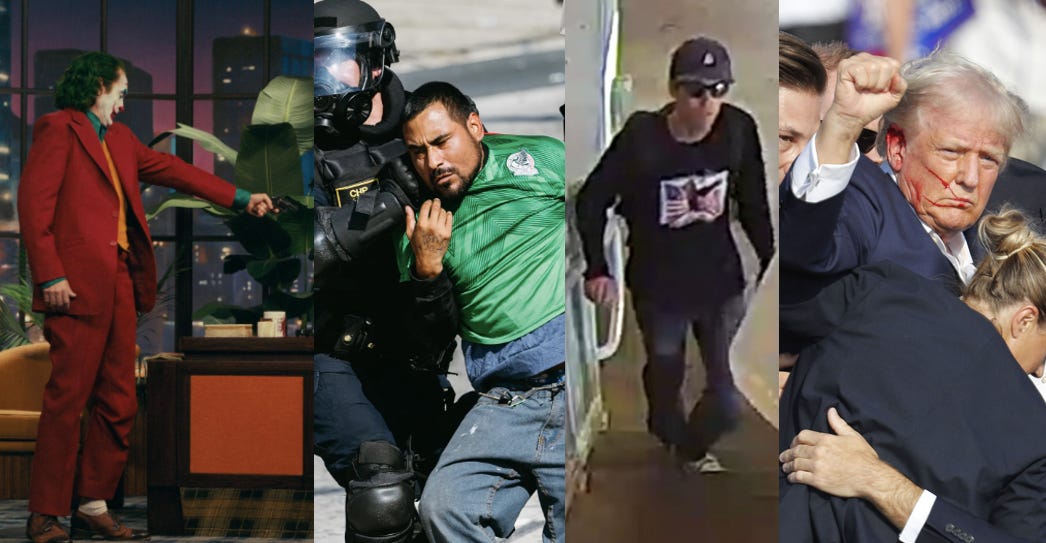
The left speaks of violence as something divided, as a twofold act which can be deployed against itself. This apparent division seemingly operates across ICE raids, the killing of Charlie Kirk, the attempted assassination of Trump, or even the spectres of revolutionary violence. The left firstly speaks despairingly of an everyday integration of violence in economics and industry. When Western leaders, for example, speak of the need for ‘law and order’ within our borders, we are of course right to point out that this domestic law and order is inseparable from a violent foreign disorder. Western stability thrives on the permanent instability of the third world (a term which is of course barely applicable today): economic growth has become dependent on violent oppressions in the Middle East or Latin America; private industries thrive on financing African warlords or the child labour of coltan mines; and trade with India and the Far East is complicit in ongoing caste systems and modern slavery and human trafficking. In this sense, violence and order are not opposed, but on a global scale operate in a perpetual tango. From the perspective of the State (and as we see clearly in figures such as Hobbes or Hegel) violence towards citizens is even inherent to the inaugural instance of Law itself.
At the same time, the left speaks encouragingly of the violence carried out by the people - a latent or potential violence - which would act as a countermeasure to this cruel displacement of domestic violence to foreign violence in the name of law and order. This popular or mass violence opposes what Walter Benjamin calls law-upholding violence. The left’s violence, which in the traces of Bolshevik dreams would install a new social regime, is something of a law-establishing violence. Benjamin is at the same time right that the very essence of law-upholding also reflects a constitutive, law-establishing violence: in the police, for example, law-upholding is not the main priority, since the law itself is often forced to mediate and dispute police actions against their victims. But the inverse of Benjamin’s argument is also true, law-establishing violence (the type of anti-establishment violence avowed by the left) is often indirectly law-upholding - it justifies the very system it rejects. Consider, for example, the modern anti-capitalist or anti-occupation protest. It is very clear that most such movements - which often explicitly call for a radical reconfiguration of the law - come to expect the law they are opposing to be upheld and defended. They expect police crackdowns and arrests, and it is this very opposition which they in fact desire and through which they define their protest, rather than by the explicit ends the protest avows.
The enjoyment of modern protests is not derived from change itself, but from the basic fact of the resistance to change that they encounter. What eventually comes to be the defining moment of the modern protest is the exercise of the very law that is being rejected - through this law, the left feels validated. The violence of the left is, paradoxically, validated not against but through the law - in attempting to establish something radically new, they uphold the existing system. It is not the change latent in a protest which matters, but the fact that the protest is shut down. A perverse relation to political change therefore operates for the new left: as long as serious change (the goal itself) is obstructed, the goal is virtually kept alive.
If the left was given a hypothetical go-ahed to seriously change the world, to end oppression and international violence, they would have little clue what to do. It is this very inadequacy which the left must fix today. What they desire is to uphold the law from the other perspective, from a perspective in which their desire is opposed. The goal of the left today, then, appears to unfortunately be a goal which exists only by being unactualised. The left’s vision of violence is in other words never divided in the way it first thought - it enjoys the protest just as much as it gains some transgressive jouissance (or self-contradicting enjoyment) at the protest being shut down by police. After it is shut down, protesters go to Starbucks, get a drink, or passively reminisce about the events of the protest itself. ‘Protest’ and ‘outrage at a blocked protest’ eventually become the same thing. We protest from a self-reflexive future anticipation of our own failure - in fact, the possibility of outrage at the failure of protest is the very hope which fuels it. If the left is to make some form of difference, we should firstly recognise these discrepancies. We should recognise that even acts of opposing the law are mediated methods of upholding it.
Rather than breaking from the law, the left identifies with the image that the law imposes upon it - it may be a negative identification, but the left has become unable to truly think outside the coordinates of the current status quo. This is, of course, not an inherent failure of the left, but as Mark Fisher already pointed out, a feature of (post)modern capitalism itself: it embodies its own alternative - anti-capitalism is simply a new function of capitalism. With this, I suggest that the first step in this direction is to insist on the specific form of the role and need for violence in the 21st century. In the anti-colonial call-to-arms of Franz Fanon or the anti-oppression rhetoric of civil rights movements and the Black Panthers, the orthodox view of violence by the modern left emerged. Violence by the oppressed is always a corrective violence or counter-violence.
The liberal position, claiming to take a sober and more historically informed view of violence, is neatly summarised by the view of Steven Pinker: all revolutions have been a failure. The French Revolution reversed itself into indiscriminate terror, the Russian Revolution ended in dekulakization, the gulag, and failed industrialisation, the Cultural Revolution ended in mass starvation, the Cuban revolution stagnated an entire nation’s economy, Arab Spring led to the atrocities of Arab Winter - in conclusion, revolution and violence, for Pinker, are bad. This position of course performs a jump which characterises violence as exclusively the type of violence carried out by revolutionary leftist movements - and in addition it misrepresents this same violence. Whilst his is of course a nonsensical argument, Pinker is unintentionally (and unfortunately) right about one thing: everyday violence on behalf of the dominant system and revolutionary violence are entirely different. The violence of the left cannot simply frame itself as ‘counter-violence’, since this image of violence is already coded by the logic of the system it rejects. One of the failures of the modern left is to recycle the outdated view of violence as that of Fanon and anti-colonialism, where all anti-establishment violence is simply counter-violence. This thinking is precisely what dooms modern protests to define themselves by their own failure, by the opposition they meet which defines the narrow coordinates of their own violence. It is time to recognise that a new definition of violence - a definition of violence suited to the perplexing and disorienting formlessness of 21st century capitalism - is required.
When we look at Hannah Arendt, on the other hand, an argument on violence emerges that seems at first unexpected: violence, she claims, is the very thing which is absent in power, or in a powerful constitution. But power has, for Arendt, a very narrow definition as the power of the people. True power would be that of an Athenian direct democracy, in which the will of the people is immediately reflected in every action of the State. Such power does not, by extension, necessitate violence - in fact, it would exclude violence since there is no need for violent exchanges where an entire population sees itself recognised in the law. Unfortunately, this vision of power and violence finds no receptacle today. It is clear today, as it was clear long before Arendt, that the constitutive instalment of Law implies a violence, and that the continuation of legislative power implies the displaced rejection of individual freedom. In fact, it is absurd to claim that the power of private capital, of oligarchic techno-capitalism isn’t ‘really’ power because it is not ‘democratic’.
To speak of violence today implies recognising a certain division at its core - a division that is not only historical (clearly seen by the many opposing treatises on violence produced so far) but also conceptual. Passivity may in fact be inadvertently violent - Freud already noted this when he speaks of the famous dream of the white wolves on a tree in the Wolf Man case, where the very act of uncanny immobility conceals a direct and traumatic violence against the subject. This ‘violence of passivity’ is adopted by strikes, which hope to disrupt the status quo by the simple act of doing nothing, by refusing to act. But not only is passivity sometimes violent, the growing fact which the left must also confront is that its own violence is in fact a form of passivity. Passive violence and violent passivity are becoming increasingly indistinguishable, and the two opposed positions are becoming increasingly identical.
In fact, Benjamin’s distinction between violence in the form of law-establishing and law-upholding becomes more obscure when we recognise Benjamin’s own argument that constitution and reproduction cannot be separated in the period of accelerated mechanical reproduction. Where modern capitalism acts as its own opposite, as the opposition which it internally presupposes and to which it in turn adapts, one of the more scathing cuts to the old ideals of violence (as either in service of the hegemonic system or in the service of a revolutionary movement) is that violence becomes its own countermeasure. Violence is today an increasingly obscure and impossibly defined category. Against this endless and tactically complex reframing, division, and redefining of violence which approaches it as a fragmented and divided concept - against historical considerations of violence which soon appear to discuss violence so as to indefinitely postpone it - we are tempted to draw some anti-hermeneutical, arbitrary declaration: “violence is justified!”
Violence, in this anti-hermeneutical declaration, is not simply justified under certain conditions and prohibited under others, or divided between State violence and the violence of the people. Violence may not even be an act which abolishes any divisions, but the current state of the world does not require it any less as a consequence. In fact, the very indeterminate structure of modern capitalism calls for a groundless, inconsistent violence all the more. Climate change, genocides, and global exploitations have been critically discussed to little avail, and it is tempting to simply insist on an indeterminate principle of violence as a simple passage a l’acte, a purely un-symbolisable and unjustified movement (or rupture) which lays the foundation for a different type of engagement with the world.
Interestingly, this pure and irreducible act as constitutive of a world for which this ‘act’ remains inarticulable was already described in the early 19th century by Schelling. For Schelling, the ontological relation between identity and difference (between a principle of identity out of which ‘things’ can be claimed to be identical and a principle of difference out of which ‘things’ can be claimed to differ) faces an interminable tension unless a “blind act” of violence is posited. This inarticulable rupture in the relations of existent things acts as a gap which retroactively posits identity as preceding difference. In fact God himself ‘commences’, Schelling argues, by positing in himself a negation which cannot be assimilated to God. In other words, God cannot in abstraction account for and justify himself, and in this endlessly negative self-relation he is forced to posit as central to the identity of God a component of purely dark, un-Godly negativity which can never be identified to God: God is forced to posit his own becoming by violently installing a past from which God emerged, and yet a past outside of God which emerged by the irreducible strength of God’s own will.
Schelling’s logic of a rupture which retroactively justifies itself, which is grounded by the fact that its own cause appears absent, becomes personalised in Hegel’s master-slave dialectic (where the slave becomes the embodiment of his own absent or self-negating recognition in the master), and rendered all the more dynamically unstable in his Logic. For Hegel, the very basis of a certain self-identical principle of stability, in which a thing can be momentarily claimed to be identical to itself, presupposes an endless conjunction between being and nothing, or rather between being as constitutively and interminably (retroactively) including in itself what is incompatible with being (nothing).
Via German Idealism, then, it seems that certain acts of violence are constructive only insofar as they are radically spontaneous, insofar as they contain no principle of pre-meditation. We are, of course, forced to ask what such a vision of violence translates to on the purely material, everyday plane. In other words, what about when violence is purely simulacral (without a determinate origin), when its core tenet is nothing other than that it has no core tenet, that it is an initially empty gesture that finds its justification only after it has taken place? Such violence seems to disapprove of pre-meditated categories - it seems incompatible with either of Walter Benjamin’s forms of violence, either as law-upholding or as law-establishing. This form of violence justifies an impersonal authority only by being deployed without any justified ground. We see this not only in the cruelties of purely reactive military-fundamentalist regimes such as in Myanmar or even with the logic behind Nagasaki and Hiroshima (which did not occur because of some pre-established means-ends calculation) but also in the the avatars of sympathetic and often anarchic movie villains.
The Joker is such an example. Joaquin Phoenix’s Joker partially expresses this purely performative violence in shooting Robert De Niro on live TV as a simple reaction against the fact that people are mean, and that something in Gotham has to change. But the more accurate example is Heath Ledger’s Joker in Christopher Nolan’s The Dark Knight. In the hospital scene with Gotham’s district attorney Harvey Dent (now Two-Face), the Joker mocks Harvey, whose girlfriend he has just killed, by asking him, “do I really look like a guy with a plan?” This unplanned and purely gestural violence acts as the cinematic counterpart to the Schellingian rupture which furnishes a new logical order to which said rupture itself is irreducible. Whatever might come from the Joker’s actions, the outcome is certainly one in which the Joker himself will be excluded, or which the Joker could not not have foreseen. The Joker has no pretensions of being around for the outcome of whatever he does.
Other film villains can be placed in the same category of a purely simulacral violence, of a violence without any preconceived origin. Anton Chigurh of No Country for Old Men places the distinction between violence and non-violence in the hands of pure contingency - more specifically, a coin toss. In Seven, the psychopath John Doe, who eventually murders Brad Pitt’s wife and places her head in a box for Pitt himself to later discover, acts as an investigative enigma, always seemingly innocent and an open ethical question which complements the blurring of ethical lines which has always been present in detective stories (detectives always go after criminals, but at the same time they always appear somewhat ‘outside’ the bounds of the law, taking the law into their own hands). There is even Hannibal Lecter, a truly postmodern criminal who violently and without motive combines the categories of consumption and scientific (investigative) progress which were conveniently kept separate during the period of modern industrialisation.
In the cases of such villains, the justification of their violence always occurs after the act itself, and it is in this view of violence that Schelling is unexpectedly reflected, a contingent and spontaneous self-grounding of identity in a rupture, a violent act which cannot be integrated with its effects and even with the past which preceded it. For Schelling, this violent act is in fact constitutive of its past. This view of violence as permanently irreducible recurs in a more pragmatic sense in the work of Lenin, specifically during a reflection from State and Revolution. Violence, as Benjamin argues, is a function seemingly inseparable from the law as such - it is by legislative and executive means that what is understood as violence (and as just or as unjust violence, as anarchistic excesses or as necessary, i.e. State administered, violence). Lenin makes the additional argument that the question of lawful versus unlawful violence simply does not apply in the case of popular, anti-capitalist mobilisations. If the essence of such revolutionary practices are to reject or rather disregard the established law, then it is impossible to seriously claim that such violence is lawful or unlawful. It is neither counter-violence nor is it a rejection of violence. It is a reconsideration of the basic coordinates on which violence and its legal status are posited.
On the question of whether violence is acceptable or justified today, whether it is State-administered violence or anti-State violence, the first question depends on recognising the deadlock inherent to violence which a historical or conceptual perspective introduces. Whilst law-upholding violence is sometimes itself law-establishing (in the case of police) it is clear that even the most radical law-establishing violence is in itself inversely law-upholding. Regarding the violence of the State, the problem is not so much a critique of law and order as a displacement of violence onto foreign territories (although this type of critique was and continues to be necessary). Instead, a critique should target why this specific configuration of law and order and violence appears to be the only one thinkable, and why a critique of hegemonic violence in itself implies a critique of the basic coordinates of law and order. Revolutionary violence does not necessarily exclude law and order.
The principles of anti-colonial counter-violence, where in the eyes of Black Leninist-Marxists, Sartre, or Fanon, for example, all revolutionary violence is simply an inversion of the violence dealt to them, should be contrasted with the type of simulacral violence seen as much in Joker as in Schelling, whereby the act finds its justification retroactively. To understand the justification of violence today, a justification which I think is nonetheless becoming increasingly permissible, the first step is to stop drawing distinctions between different forms of violence, and instead to frame the violent acts as its own double, as internally embodying the very opposite of its own intention.
As a final note, violence as an object can be reframed be the difference between the Lacanian and the Kleinian view of the subject-object distinction. Lacan performs a Hegelian move: the intraversable gap between the subject and its desire (desire located in the objet a, in excess of the symbolic coordinates in which the object relation is established) is always displaced as the subject’s impossible identity to itself. The subject is always ‘something more’ than the speech and discourse in which it is posited. This ‘something more’ - a self-reflexive inconsistency which simultaneously situates subjecthood inside the symbolic structures of the Law as well as outside them, as their exception - is the point of attack by Joan Copjec on ‘historicism’. The Foucauldian historicists which posit the subject as the outcome of discursive practices miss that this subject is always oriented to what is irreducible to discourse - to the Real of desire. The Lacanian division between subject and its object of desire is in fact a division and incommensurability of the subject to itself. The Hegelian movement is very clear here: for Hegel, the disparity between two registers - whether substance and subject or Spirit and nature - is always retroactively relocated as in fact being an internal disparity between one system and itself.
For Klein, on the other hand, the division is inverted. Unconscious phantasy, which mediates the phenomenal systems of experience and intersubjectivity, displaces this division onto the object itself. The breast or the phallus, for example, are not consistent experiences, but rather marked by the very thing which these objects do not at first imply. Their attributes - of goodness or of satisfaction – are just as much characterised by their own opposite: despair or evil. The problem, in the Kleinian frame, is not only that we are active obstacles to our own freedom (as Julia Kristeva points out in her book on Klein) but that the very objects which would furnish freedom are the objects that simultaneously prohibit freedom. There is, in other words, little to suggest that we can experience ‘neutral’ objects. Instead, objects comprise an alterity or division which is only retrospectively noticed at the moment of our misuse or miscomprehension of them. Unlike Lacan, Klein outsources or transposes a ‘division of the subject’ onto a self-contradictory inconsistency within the object itself.
In this sense, whilst Lacan is close to Hegel, Klein approaches the poetic imagination of Gaston Bachelard: every object at the same time comprises its own alterity, or that which it is not. The ‘poetic’ or imaginary construction of objects is, for Bachelard, a speculative and ever-incomplete meditation on objects which unearths their central opacity. More specifically, to articulate a material object through poetic or imaginary discourse is to indirectly frame the internal division or ontological non-identity of the object towards itself – that it is in part constituted by rejecting itself. The object of violence is, therefore (and in a Kleinian frame), an object which is experienced as its own opposite, as a passive principle. Any serious and politically valid form of 21st century violence could benefit by beginning with this Kleinian logic of the object of violence.
The subject of passivity in bureaucracy reminds me of Zizek’s anecdote about the secret police in Cuba. When they developed technology to track vehicles, Castro said, ‘Wonderful, now there will no longer be black market smuggling!’ The secret police said, ‘Are you crazy? Our people are starving, the only thing that allows them to survive is the black market!”
The secret police is not only passive towards its obligations but pro-active against its duty. You’re right, it is a sort of ignorance that truly makes a great bureaucrat.