
Hypercompleteness: Reply to Žižek
Žižek's Oddly Shaped (Incomplete) Coin

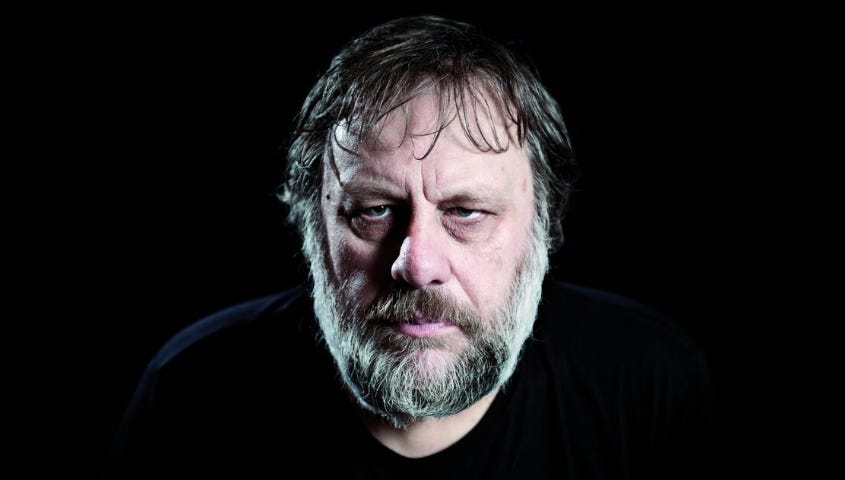
In an article for Crisis & Critique, Slavoj Žižek recently (interestingly) responded to my short critique of his notion of “ontological incompleteness”. My current reply is part of a longer criticism of Žižek’s work, which is unfortunately currently under review but for which I have shared a pre-publication draft here. For anyone interested in my problems with the great Slovene Lacanian, do consider reading it.
Unlike Žižek, who argues that reality is ontologically incomplete, I argue that incompleteness fails to grasp the true contradiction of reality: rather than just ‘missing a piece’, reality occupies incompatible, mutually exclusive positions. Reality is “hypercomplete”: it ontologically presupposes a ‘more than itself’ which is not merely the counterpart to (but rather irreducible to) incompleteness.
In his detailed response to my shorter piece on incompleteness versus hypercompleteness, Žižek accuses me of several errors: of sympathising with Jung, of being a non-admitted Deleuzean, and of refusing to accept a fundamental Lacanian tenet, lack. Žižek’s recurring point, however, is that incompleteness and hyper-completeness are two sides of the same coin. The true Lacanian-Hegelian position, he insists, is to acknowledge that lack is the very (non)thing according to which excess (or surplus) and contradiction become possible. Hypercompleteness would, then, be little more than the double of a constitutive incompleteness – hence the two positions being ‘two sides of the same coin’. But this is certainly an oddly shaped coin. If Žižek’s coin exists, it is, in fact, conveniently (and impossibly) one-sided – or more likely, it is an imaginary coin which never lands after it is tossed. To argue that incompleteness is merely the other side of (or the ground to) excess or hypercompleteness (two terms which are not identical, as I will argue), is to ascribe an optimistic symmetry between two ontologically incompatible positions. Žižek rightly suggests that we disagree on the function of ‘lack’ in the Lacanian-Hegelian orientation, and yet my argument is not that lack does not exist, but rather that the lack which he locates at the heart of hypercompleteness is in fact an epistemological discrepancy within an ontology of perpetual overdetermination or self-contradictory presuppositions. In other words, there is no symmetry between incompleteness and hypercompleteness. Incompleteness is instead the subjective inscription of an objective overdetermination in the fabric of objective reality itself.
To reuse the often-misunderstood Freudian logic of überdeterminierung (overdetermination), when material or symbolic reality contradicts itself, when it produces an absurd number of mutually incompatible logical premises, this contradiction is inevitably subjectively registered as an incompleteness (‘there is no final answer’), but incompleteness should not as a consequence be identified within this reality itself. A closer look at Žižek’s dissatisfaction with my argument will make this error of conflating incompleteness and hypercompleteness clearer. At the beginning of his response, Žižek suggests that I have missed (or misunderstood) the logic of retroactive causation so crucial to Lacan and Hegel: the logic where a formation furnishes its own possibility only after it has come into existence (which lays the foundation to its own becoming, posits its own presuppositions).
This retroactive causality, I have already argued, is the essential moment of Hegelian logic: the interminable transition between being and nothing, in which neither precedes the other, finds its ground only in the presupposed essence which is at the same time the culmination of the simulacral reciprocity between being and nothing. The outcome of the becoming of being and nothing is, in other words, simultaneously the retroactive presupposition for this becoming. But the only possibility in which such a retroactive causality is possible, however, is by a contradiction in which ‘substance’ fails to account for its own outcome, where a thing is retroactively constituted (or momentarily stabilised) by the fact that it is fundamentally more than itself – this is most clearly concentrated in the Hegelian figure of the monarch (a favourite of Žižek’s). Things can be left incomplete (as Werner Herzog reminded us apropos the jungle) but hypercompleteness requires a perpetual auto-reconstruction in order to ‘bind’ the presuppositions which are contradicted in their actualisation.
Let’s return to Hegel’s Rechtsphilosophie. The monarch, as a purely performative and empty re-affirmation by the State of its own constitution, is where the difference between ‘existence’ (Existenz) and ‘constitution’ (Verfassung) emerges, or a constitution which retroactively vindicates existence as existing in accordance with its own concept. At the same time, by looking at the Hegelian monarch, we spot that this retroaction is nestled within the idea of hypercompleteness. The three-body division of the State, as Hegel argues, is by itself necessarily incompatible with an ethical articulation of the State as reciprocally embodying the freedom of its subjects and the subjective freedom of the State. In particular, the legislative body appears to comprise a profound discrepancy: it constructs legislative relations which do not consistently ‘add up’, and which instead appear to oppose each other, to contradict the basic premises of a Law which guides civil conduct (hence the constant interception of a moment of judgement on the Law – the judicial body). As a whole, the Law (in a Lacanian sense) operates by rejecting its own authority – the Law is, in an obscure way, always postmodern, always a decentralised relativisation of itself where Law and self-contradictory Law are indissociable. And yet the Law is not merely incomplete. It is not the case, for Hegel, of adding just a handful of additional legislative measures in order to make the Law a consistent whole. It is located in the basic constitution of the Law that it seems to operate beyond itself: strangely, we can use the Law for the explicit aim of countering the Law itself.
The existence of the State in its three-body form, then, is not ‘incomplete’ – it does not lack an ontological fulness – nor is it consistently whole. Instead, the existential coordinates of the State seem to add another dimension to it, a dimension which the State fails to express, and which leaves it in a contradictory deadlock. The apparent incompleteness of the Law/State is a spectral impression, a sentiment even, generated by the hypercomplete structure of a State which is forced to posit itself as more than just its existent from. This ‘more than existence’ is what emerges, Hegel argues, by the State eventually being constituted. A secondary instance, an instance which reconfigures the inconsistent excesses of a legislative totality that cannot account for its own logic, becomes necessary for this constitution. The already-existing State is retroactively constituted as being what it is (a concrete embodiment of freedom) only by an affirmative symbolic figure – a singular subjectivity which acts as the empty inscription of the totality of the State: the monarch. In the purely performative figure of the monarch, the existence of the State is retroactively constituted: its inconsistent appearance is re-posited not as a deviation from the ground of freedom, but as the expression of an inherent inconsistency in the concept of freedom itself.
The State retroactively posits its presuppositions as embodying an inconsistent freedom, rather than inconsistently deviating from a consistent freedom (which does not exist). Ironically, this very retroactive causation from constitution to existence is grounded in the impossibility of arguing that the State is substantially incomplete, but rather in the fact that it is complete in excess of its own coordinates, that the State is, at first, its own opposition. This hypercompleteness is what the monarch stands for. The monarch does not ‘complete’ and incomplete existence by filling in what is missing in the coordinates of the Ethical State. Instead, the monarch is more self-reflective: he halts the perpetual self-effacement of the freedom of the State by retroactively constituting its existence as nothing other than this self-contradictory legislative-executive-judicial existence. And yet Žižek would probably say that we have returned to his coin: that incompleteness is one face of hypercompleteness. Not only would Hegel argue that incompleteness and contradictory excess do not occupy the same ontological position, but I will return to Žižek’s response in order to suggest that the experience of incompleteness he ascribes to reality is secondary to a constitutive self-opposition lodged in reality.
If I have misunderstood retroactive causality, it is clear that Žižek has himself fallen prey to its subjective (rather than objective) manifestation by ascribing a latent symmetry between incompleteness and hypercompleteness, or even between subject and object. As Žižek writes, “for a Lacanian, lack and excess are two sides of the same coin, like subject and object.” The problem with this argument can be seen not via a Deleuzean or Nietzschean frame (which Žižek accuses me of prioritising) but already by a radically Lacanian argument very close to Žižek and yet incompatible with the idea that ‘subject and object are two sides of the same coin’ – an argument provided by Alenka Zupančič. For Zupančič, subject is not merely the other side of object – it is not an empty obverse of what has gone wrong in the objective world. Subject is, as she argues, a type of impossible (or self-excluding) set. Rather than acting as the obverse of the objective world, the subject acts as a discordant registration of this world (by itself).
Much like a set that does not belong to itself and the set of sets that do not belong to themselves are radically different (as Bertrand Russell awkwardly showed, the latter is a type of impossible paradox that both does and does not belong to itself), the subject is a set representing an anomaly in reality, an anomaly in the world which is not directly present to the world. Subject is, in other words, a contradiction or singularised disharmony in the objective world, rather than its symmetrical opposite. To argue that subject and object are two sides of the same coin is therefore to misrecognise the far more uncomfortable position of the subject[1]. Of course, Žižek is likely to agree with Zupančič here, but he cannot do so and simultaneously insist on a forced symmetry between subject and object as two sides of the same coin. If subject is a negative registration of an objective disjunction (if subject is, in the old Freudian sense, an always-imperfect compromise formation or symptom), then its negativity is secondary to a radical self-countering tendency within the objective world. If the world is ontologically incomplete, then subject is its other side – an imperfect solution which produces symptomatic excesses in the form of jouissance. But if, as I argue, the subject is a self-contradictory registration of an ontological deadlock, it is because incompleteness is secondary: the world cannot account for itself, it produces effects which are outside the scope of the world’s own coordinates. This self-inscribed ‘overflow’ is where an imperfect (self-obscuring) subject is posited. But the ‘incompleteness’ of this subject is not an incompleteness in reality – it is simply a failure of the subject to truly mirror the hypercompleteness of the world itself. Incompleteness is, in this sense, a secondary phenomenological or epistemological experience of the asymmetry between subject and object, a displaced concealment of the hypercompleteness which ‘lack’ cannot properly articulate.
The Hegelian argument is not simply that lack or nothing precedes being – it is not simply that being is always-already founded on an a priori incompleteness. The more paradoxical Hegelian claim is that being occupies incompatible positions: it is simultaneously both itself and the nothing which is irreducible to itself and which it both posits and presupposes. Being and nothing do not merely indefinitely and retroactively presuppose each other, but their impossible relation in turn acts as a registration that being is disjunctively related to itself as more than itself. Being is articulated in relation to the concept (begriff) because it is perpetually in excess of what being itself is. As such, the registration of being as incomplete fails to recognise how it can be both itself and the nothing with which it is incompatible. Lack is, in Hegelian logic, always the subjective registration of an all-too-complete and contradictory ontology.
There is, however, a subtle difference between the Lacanian and the Hegelian position regarding being and lack. This difference is glimpsed when Žižek suggests that “the difference between Holmberg and me does not lie in the opposition between incompleteness and hypercompleteness” – perhaps this is true, there is an opposition here, but Žižek ascribes a symmetry between the two which I argue is not possible – “Holmberg would probably reject the notion of a basic failure which evokes lack and incompleteness.” What is my difference? What I oppose is not so much the notion of an ontological failure, but of an ontological failure to be complete. It may seem a small difference, but it has serious ontological implications. The failure of reality lies in its presuppositions being in perpetual excess of the logic of its existence. Far from being incomplete (whatever this incompleteness actually looks like), the more bewildering problem is that reality cannot be reconciled to itself without simultaneously contradicting itself (a contradiction not grounded in incompleteness, but in being too much for itself to handle).
What is worth stressing here is that hypercompleteness does not merely signify excess. Excess may well be the symptom of lack, as Žižek would argue, but excess in this sense signifies a certain sporadic creation of a surplus something which covers this lack. Hypercompleteness, on the other hand, is not a secondary reaction, but ontologically foundational. It reflects a deadlock in the basic premises of the thing itself. It is not simply that the thing (being, reality, the symbolic) is incomplete and overcompensates by an excessive hypercompleteness. Instead, and as Hegel argues, the thing is already indefinitely more than itself. Hypercompleteness is ontologically installed and does not imply the secondariness of excess/surplus. It is in this sense, I argue, that we begin with an ontology of hypercompleteness – the experience of being as lacking is just this, an experience: what the imperfect subjective position reveals is that reality occupies multiple contradictory positions. Lack does not feature here except as a subjective negativity which is caught up in a self-defeating reality. But unlike Hegel, the early Lacan did in fact suggest that ‘being lacks’, and through this lack that his early vision of desire operates: “Desire is a relation of being to lack. This lack is the lack of being properly speaking. It is not the lack of this or that, but the lack of being whereby being exists [manque d’être par quoi l’être existe]”.
Being, in Lacan’s Seminar 2, exists only insofar as it simultaneously lacks, or insofar as it is incomplete. And it is through this ontological lack that desire is articulated as permanently unfulfilled, as always being the desire for something else. Later, however, Lacan insists that desire is not simply the reflection of an ontological gap, but rather a discrepancy in the Symbolic register, whereby signification is incapable of accounting for or containing its own effects. Already by the time he presents the graph of desire in Subversion of the Subject and Dialectic of Desire, it becomes clearer that desire is the after-effect of a signifying chain which does not form a homogenously consistent whole, but rather a heterogenous and self-opposing excess-totality, which produces more than what this chain itself can contain. Desire points at a Real, unsymbolisable discrepancy within language: the Real is not simply a lack in being, but an overestimation inscribed within the Symbolic. Desire expresses a material limit in the Symbolic, an impasse which contradicts the basic coordinates of the Symbolic, and yet which is indissociable from the Symbolic. In other words, desire acts as a type of self-directed critique of the Symbolic by the Symbolic – not simply an incompleteness, but a more than itselfness within the coordinates of language in which language produces an anomaly which it fails to adhere to or to assimilate to itself. This hypercomplete anomaly, incompatible with a straightforward lack, is where desire emerges. It is this desire which paradoxically desires against the linguistic coordinates in which desire is coded, and for which it must be propped up by the Other.
In his later seminars, such as Seminar 17, a discrepant absence is located not in relation to ontology as such, but in relation to the speaking being. The question for Lacan is not what is gained in our relation to the world by the introduction of language, but what type of loss is constituted by language. This loss is located on the subjective side, a subject for which there is no sexual relation, or which can never be identical to the discursive register in which it is posited. Subject – as subject which lacks a sexual relation – is therefore implemented by the antagonisms of the discursive field, by the permanent contradiction lodged in the premises of language. The subject (as subject of the unconscious) therefore always touches the Real, the disjunctive inconsistency lodged in yet irreducible to discourse – and this Real is nothing more than the impossible relation of the Symbolic to itself, a folding of the Symbolic into a contradiction with its own coordinates. If the subject (or the speaking being) lacks, it is because of its asymmetrical relation to the Symbolic – because the Symbolic is both what it is and more than this, it occupies incompatible (hypercomplete) positions, and renders the subject a retroactive, self-absent, implication of signification.
It’s worth returning to a Hegelian perspective, which more concretely summarises the incompatibility between incompleteness and hypercompleteness. The great Hegelian thesis is that subject is an internal moment of substance, and yet an exception, a part which in its internal manifestation appears as if from the outside, or as in intimate exteriority (étrangeté intérieure) to borrow the Laplanchean term, and reconstructs the very whole to which it belongs. Substance is not incomplete – substance collapses into itself to produce a subject. Subject is therefore one of the many expressions of substance, and at the same time an overdetermined expression of substance where substance divides itself from itself and in so doing violently rearranges itself. Incompleteness is the imperfect registration of a more radical impasse. Incompleteness cannot avoid implying a nothing as the moment which renders substance incomplete, which installs a stasis between being and nothing in which he two are eventually neatly separated. But what is more perplexing is that this same nothing both is and is not a part of reality. Being is not left open by a persistent nothing. The first point of departure is rather that being is more than it can account for – it is hypercomplete. Incompleteness is not the symmetrical obverse of hypercompleteness, but rather a retroactive, epistemological registration of a totality which is more than itself. Unlike Žižek’s claim, it is impossible to maintain a symmetry between incompleteness and hypercompleteness. Put simply, being does not lack anything. The ontological disjunctions nested in reality are more radical than simply signalling an incompleteness – being does not lack, it is overdetermined. Incompleteness is an epistemological registration or side-effect of a foundational ontology of irreducible hypercompleteness.
[1] Zupančič does nevertheless flirt with the notion that the subject as an impossible set exists only as a consequence of an objective insufficiency within objective reality (whether this is reality in its material-scientific structure or its Symbolic-linguistic coordinates). Although this is an argument be had another time.
For me, the core of the text lies exactly where the ontological question shifts. Reality is not missing something, but rather it is larger than any description we can give of it. What appears as incompleteness is not a lack in being, but the subjective experience of a reality that contradicts itself, is overdetermined, and presupposes more than it can ever fully integrate.
I think of the sea – but not of swimming in it, rather of traveling by boat. The boat is important: it stands for orientation, technique, decision, course. You are not at the mercy of the elements; you have instruments, maps, experience. You can choose where you go. This is thinking.
So you move through the sea, and for a long time everything functions as it should. The sea is there: buoyant, calculable enough to allow navigation. It carries the boat. It permits direction.
And then you reach a point where something shifts. Not because the sea suddenly disappears. Not because your instruments fail. But because you encounter a boundary of consistency.
The sea is there – and simultaneously not there.
Not in the sense of an illusion, but in the sense of an objective self-contradiction: it continues to carry you, but it can no longer be unambiguously determined as "what it is." It is surface and depth, carrier and abyss, medium and interruption all at once. None of these determinations is wrong, but none suffices. The sea contradicts itself not temporally, but simultaneously.
And precisely here arises the registration that is too hastily called "incompleteness." But what you register is not a hole in the sea. It is a point at which the sea presupposes more than it can itself stably maintain. Your boat does not sail to the edge of the world, but to a point where the world no longer cleanly adheres to its own coordinates.
The crucial point: this experience is not merely subjective. You are not hallucinating an abyss. You encounter a real structure in which being itself does not coincide with itself. Your sense that "something is wrong here" is the epistemological signature of an ontological tension.
In this sense, the idea of hypercompleteness convinces me where it understands incompleteness as an epistemological registration – as an impression that emerges when a reality is more than my perspective can bear, but also: more than it itself can be. It becomes less convincing for me where this idea itself wants to become a stable ontological coin again.
I would therefore not say that incompleteness and hypercompleteness are two sides of the same coin. Rather, incompleteness is the imprint that a contradictory reality leaves in a limited position – a reality that does not suffice for itself because it cannot be grasped as a unified, self-contained whole.
This is not a lack that needs to be fixed, but a simple condition of life: to travel by boat on a sea that is there and not there at once. You can continue sailing. Not because the contradiction disappears. But because life – and thinking – happen precisely where the sea carries without having to be coherent.
Thank you very much for your text; it is very illuminating and helps me greatly to visualize a potential Zizek-Deleuze-Laruelle debate (Zizek, in his works from the 90s and 2000s, provides the foundations, but since he establishes his own coordinates, I sometimes find myself lacking other perspectives).
And I wonder: would you say your position is that of Deleuze, but not the Deleuze of «A Thousand Plateaus» or «Anti-Oedipus», but rather that of «The Logic of Sense»? The Deleuze of «The Logic of Sense» develops a technique that already appears in «Difference and Repetition»: an instrumental and heuristic dialectic—not a dialectic of reason, or a constitutive use of reason in Kantian terms, but a dialectic like that found in the work of Sacher-Masoch (according to how Deleuze understands Dialectics in his preface to «Coldness and Cruelty»).
I am also thinking of how, in «The Logic of Sense», he understands contradiction and speaks of the plurality of senses that clash and coexist in the way you express, separating lack from overdetermination. Is it how Deleuze articulates the problem of depth, the organ, and the real, alongside surface effects and conceptual overdetermination, revolving around the figure of an empty signifier? Your post reminds me very much of the dialectical structure—yet compatible with modern mathematics and modern brain analysis (variable areas)—of the Question-Answer method