
Disaster Planning with Herodotus
Trump's Desire, Speculative Catastrophes, and the Historiography of the Present

There are many things that the historian Niall Ferguson can (and should) be criticised for: his Thatcherite politics, largely blaming the Israel-Palestine conflict on Palestinians and Hamas, and even his insulting romanticising of Henry Kissinger. But as is often the case with conservative and reactionary authors, they accidentally open up a space for a more radical, yet indirect, critique. Through their conservative analyses of the world’s problems we inadvertently glimpse a latent attack on global structures of power and capital. With Ferguson, this latent radicalism in an otherwise conservative treatise arises in his 2021 book, Doom: The Politics of Catastrophe.1 The basic claim of the book is that there are no natural disasters. In a effective political economy with adaptable international market systems, no natural events would be capable of producing global social disorientation and economic disasters.
Natural disasters are never natural, but immanently political - they are the product of an ineffective capitalist market. When a natural event causes a collapse in a political system, Ferguson’s straightforward claim is that this collapse does not point to some quality of nature, but rather to the political system itself. Covid, food shortages, natural events are marginal to the disaster which they supposedly cause - peripheral events which nonetheless consume and have a totalising effect on the market structures in which they arise. They are not disasters in themselves, but due to the failure of supply chains, banking systems, or international alliances. Whilst natural disasters expose the precariousness of the markets in which they emerge, they always do so retroactively - they expose weakness only after this weakness has been triggered. It is here that we reach a difficulty in understanding potential political catastrophes: the task of political disaster planning is to speculate on that which can never be known in the present, but only from a future position unknown to the present.
The disaster planner must see the political situation from a future position which is apparently irreducible to the present. There is, perhaps ironically, a certain aesthetic logic to this deadlock, the same logic described in John Berger’s essay, Past Seen from a Possible Future, where Berger describes the European nude painting as sexualised after-the-fact, by the appropriation of the observer.
“The painting’s sexuality is manifest not in what it shows but in the owner-spectator’s (mine in this case) right to see her naked. Her nakedness is not a function of her sexuality but of the sexuality of those who have access to the picture. In the majority of European nudes there is a close parallel with the passivity which is endemic to prostitution.”2
Sexuality is rendered a secondary (and externally imposed) quality of nudity. The nude is a passive register which has sexuality imposed on it like an alien and de-centering anomaly. The beauty of the nude is, in this sense, the double of the prostitute: the prostitute is not inherently sexualised, but rather adopts a supplementary sexual position through a vulgar commodification by her customer. Similarly, the acquirer, customer, or observer of art introduces the sexuality which only appears inherent to the image after it has been appropriated.
If the European artistic depiction of the feminine leaves this same femininity in a type of neutral abstraction, a formlessness which is infused with sexuality only by its observer, it is because much art is articulated only by retrospection. The anomaly of the Romantics or the pre-raphaelites is that their creations incorporate an irreducible future perspective. This same ‘articulation of the inarticulable’ is apparent in the present attempts of experts to understand the precariousness of the current political situation and its disastrous dimensions. Any catastrophic event seems to be both an exception to a current political situation and its culmination. It is an enigma - an unpredictable disturbance apparently outside any political structure - and yet it reveals the internal inconsistencies of this same structure.
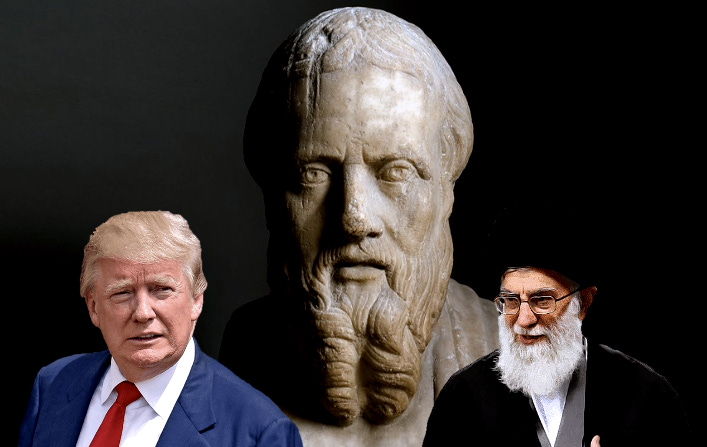
This radical dimension of an enigmatic and impenetrable perspective, a non-hermeneutic discrepancy, appears to be more and more actual when we look at Trump’s politics and the Iran War in particular. Between ceasefires, threats of annihilating Iran as a whole, attempts at negotiation, militarising the Strait of Hormuz, and insisting that the Strait be reopened - more explicitly, between claiming that he will never try to trigger a regime change in Iran and later violently trying to impose such a regime change - there seems to be no consistent logic to Trump’s foreign policy. But this inconsistency is not exactly a failure in the Trump-style of politics - it is in fact its most clear expression. It is an impasse not marginal to, but functionally implemented within, the fundamental progression of capitalist geopolitics as a whole.
It is of course valid to suggest that we do not know what Trump wants, that we cannot understand the reason behind his unpredictability. But the problem with this suggestion is the implication that it is we (the commentator or the analyst) who do not know what he wants. On a more radical level, the question of ‘what he wants’ is incompatible to any single decision made by Trump. There is no consistent, contradiction-free version of what Trump really wants. Trump’s politics are instead defined by the absence of such a logical core, his politics comprise an internal anomaly, an anti-interpretational and non-perspectival disturbance which can only ever be discussed after its effects have been made clear.
Put simply, there is a speculative and ‘non-realised’ dimension to the everyday and to the structures of capitalist geopolitics - an enigma momentarily captured by Trump’s Iran policy. On the empirical level, everyday politics cannot simply be understood for what they are. They must be understood as comprising something which is irreducible to any present articulation, an imaginative and non-real component. In this sense, there is a strange form of historiography active in the present. This historiography, I argue, is one that we can identify by going back to the Ancient Greek historian Herodotus. Herodotus’ superiority over Thucydides was that, unlike the latter, he recognised that a simple and empirical account of historical facts easily defeats itself, that no actual history can be faithfully reconstructed by relying on impersonal and ‘neutral’ progressions of events.
The empirical can never in itself be historical - it is devoid of temporal and ‘event-like’ progression. In Herodotus’ method, history requires an engagement with non-empirical, speculative and narrativised accounts. History has to enter both the known and the unknown, it must lay claim to or appropriate the subjective elements of events that cannot be directly empirically validated, which escape any immediate relationality. It is for this reason that, reading Herodotus’ The Histories3 - the story of the Greek city-states’ conflict with the Persian Empire - we see endless combinations of apocryphal personal disputes and hypothetical personal imagination with large-scale documented events. Any accurate account of the world and its history requires an obscure and speculative dimension. We cannot plainly and empirically recount the world’s history as how it appears to us. The problem today is that we are being violently confronted with this speculative and future-oriented perspective, although lodged in the present systems of politics and ideology.
Between the two great theorists of ideology - Žižek and Althusser - there therefore emerges a third alternative. Žižek and Althusser depict two variations on the interiority and the exteriority of ideology. For Žižek, ideology is materialised, it is ‘out there’ in the real world. Instead of subscribing to a certain ideological position (Protestant, socialist, Lacanian etc.), ideological relations are framed as constitutive of social reality as such. There is no baseline reality which can be neutrally represented by extracting the symbolic-ideological supplements to reality. Social reality is Its own supplement, it functions because of an impersonal enactment of ideology, by a supplementary distortion which is necessary in order for things to go on as they are.
For Althusser, on the other hand, ideology is re-staged as already active in the distinction between a subject and social reality. A subject, in Althusser’s view, does not merely confront an inherently ideological social reality - this subject is itself ideologically implemented. This is the foundation of his re-reading of Marxist interpellation. With interpellation, a subject’s supposed rejection of a cultural or ideological system implies that it is already posited according to the coordinates of the system it rejects. Ideology is in this sense already active in constituting the subject that appears to confront an ideological reality - ideology is not just ‘out there’, but is active even in the interiority of the subject that experiences an ‘out there’ of culture.
Today, however, interiority and exteriority collapse. Ideology cannot be framed as either ‘out there’ in social reality or inherent to the subject itself. Instead, ideology is the dimension of either of these which rejects any form of interpretation or hermeneutic method. Ideological processes - whether it is Trump’s foreign policy or our contradictory narratives on the climate crisis - thrive in the fact that they deconstruct established boundaries of discourse and yet leave nothing about this to be interpreted. Ideology is, in other words, a politicised deployment of enigma. What we see today, then, is a type of immanent actualisation of the speculative and irregular dimension of the world which historiography is tasked with explaining: to explain and clarify something retrospectively. Reality comprises an un-real (even temporal) discrepancy. Or, as Rancière puts it, the real must be fantasised in order to be thought’.
Herodotus’ speculative and imaginary logic of historiography is becoming more and more actual in geopolitics in a two-fold way: firstly, it is not enough to simply recount the facts. We must supplement the facts with a description of the imaginary, of a multiplicity of relevant possibles inherent to the current political impasse. Secondly, the present increasingly presupposes its future-oriented perspective. Peripheral and uninterpretable enigmas are becoming inherent to fundamental political processes, and if such enigmas are only retroactively articulated, then we must imagine the present more and more from a possible future. With the climate crisis, for example, we should ask how future subjects ecological disaster and economic collapse would explain our current disavowal of the problem.
In this way, Herodotus seems to return with violent force onto the global capitalist market, the market responsible for our current predicament. We must not only not restrict speculation, but speculate even more - to infuse the present with the constitutively imaginary dimension of a future perspective. For example, the question to ask is not simply what Trump may want from the Iranians or how he feels about Israeli pressure to reject negotiations and overthrow the clerical regime - as a general principle, what Trump desires cannot be consistently framed. We must recognise that this wanting or desiring is logically absent, that things will progress catastrophically and violently without any clear intention. The question to ask is one that furnishes a historiography of the present: how to speculatively reconstruct the present as it unfolds.
Niall Ferguson, Doom: The Politics of Catastrophe. Allen Lane, 2021.
John Berger, Steps Towards a Small Theory of the Visible. Penguin, 2020. I will also thank Dragan Alexander Wilms for bringing this book to my attention and convincing me to read it.
Herodotus, The Histories (A. de Sélincourt trans.). Penguin, 1954.